💊Psychotropic Medications: Is There Really Anything to Fear?

In this article, I will try to answer the questions most frequently asked by patients during their appointments.
As a brief and cultured introduction — one of the first modern antidepressants, fluoxetine, known in the U.S. under its iconic brand name Prozac, quickly earned the nickname “the happiness pill.” When it entered the American market in 1988, it marked a small revolution in psychiatry. Fluoxetine opened the era of a new class of medications — Selective Serotonin Reuptake Inhibitors (SSRIs). Their mechanism of action is based on increasing serotonin levels in the brain by blocking its reabsorption in the synaptic cleft. According to one of the leading modern theories of depression, an imbalance of neurotransmitters — particularly reduced serotonin levels — plays a key role in the development of this condition.

The emergence of this new generation of medications not only improved the effectiveness of pharmacotherapy, but also — which for many patients is equally important — led to better treatment tolerance and a significant reduction in both the number and intensity of side effects.

That’s just the introduction. And now... let’s dive into the answers!
Question #1: Are the medications you’re prescribing me PSYCHOTROPIC DRUGS?
Answer: Yes — and that’s not a bad thing at all. The term “psychotropic” simply refers to substances that interact with receptors in the brain and are able to cross the blood–brain barrier. These medications act on receptors located on neurons, influencing how signals are transmitted between them. That’s precisely why psychotropic drugs can effectively support the functioning of the nervous system. After all, it would be difficult to expect a medication meant to improve mood, reduce anxiety, or quiet intrusive thoughts to work without reaching the very place where these processes originate — the brain, right?
This doesn’t mean, however, that psychotropic medications “change your brain.” A better analogy would be ibuprofen or paracetamol, which bind to receptors involved in pain signaling, or antihypertensive drugs, which act on receptors in blood vessels and the heart to lower blood pressure. The mechanism is the same — the drug doesn’t rebuild an organ; it helps regulate its function.
As an interesting side note, paracetamol (acetaminophen) actually works centrally — it crosses the blood–brain barrier and acts on the central nervous system. Yet, no one calls paracetamol a psychotropic drug, do they?
Question #2: Do these medications really work, or is it just a placebo effect? Wouldn’t it be better to cope on my own — without all this “chemistry”?
Answer: Yes — psychotropic medications have proven effectiveness, confirmed by numerous large-scale clinical trials and meta-analyses (scientific studies that compile and analyze data from many independent trials to create the most reliable picture of a drug’s actual effect — see references). Their benefits are not based merely on placebo, although — as with any treatment — the placebo effect can play a small role for some individuals.
In psychiatry, the placebo effect can indeed be relatively strong — often estimated around 30%, and sometimes even higher, particularly in depressive and anxiety disorders. This stems from several factors:
✔ Patient expectations: a positive attitude toward treatment can enhance the perceived effect of a medication.
✔ Therapeutic relationship: the trust and connection with the clinician, as well as the act of seeking help, can improve well-being on their own.
✔ Natural symptom fluctuation: in some cases, symptoms may improve over time regardless of treatment.
However, this does not mean that medications work “only as placebo.” In controlled clinical trials, the efficacy of psychotropic medications clearly exceeds the placebo effect, and the difference is both statistically and clinically significant. In practice, this means that these drugs help a larger number of patients, more effectively, and for a longer duration.
The mechanism behind psychotropic medications involves modulating neurotransmitters in the brain — such as serotonin, dopamine, norepinephrine, and GABA — which helps reduce symptoms like low mood, anxiety, agitation, or insomnia. This effect is consistent and measurable, both through clinical assessment and objective diagnostic tools.
That said, it’s important to emphasize that psychotropic medications are most effective when used as part of a comprehensive treatment plan — one that also includes psychological and behavioral interventions, such as psychotherapy, psychoeducation, and lifestyle modification.

Question #3: Do psychotropic medications change your personality? Will I become a different person if I take them?
Answer: No — psychotropic medications do not change your personality. Their purpose is to regulate brain function in a way that reduces symptoms such as low mood, anxiety, intrusive thoughts, or excessive agitation. They work at the level of neurotransmitters and receptors, helping to restore balance within the nervous system.
You could say that these medications reduce the “noise” that interferes with your natural way of thinking, feeling, and responding. As a result, they help you return to being yourself — the real you that existed before the illness took hold.
Treatment won’t change your character, interests, or values — it simply gives you the ability to reconnect with them again.
Question #4: What if the medication doesn’t work — or makes me feel worse?
Answer: If a medication doesn’t bring the expected improvement — or you notice that your condition is getting worse — the most important thing is to inform your doctor and not stop the medication on your own. In psychiatry, treatment response is highly individual: a medication that works very well for one person may be less effective or cause side effects in another.
Incidentally, that’s one of the main reasons psychiatrists discourage patients from recommending their medications to friends. Before starting any psychotropic drug, a doctor must carefully assess the patient’s condition and medical history, including potential contraindications to specific substances.
If your doctor knows your medical background and previous treatments, they can:
adjust the dosage,
switch to another medication (from the same or a different class),
combine approaches (for example, medication + psychotherapy),
or, if necessary, order additional tests.
It’s also worth remembering that temporary worsening or discomfort after starting a medication can sometimes be related to initial side effects, which often subside within a few to several days — before the full therapeutic effect appears.
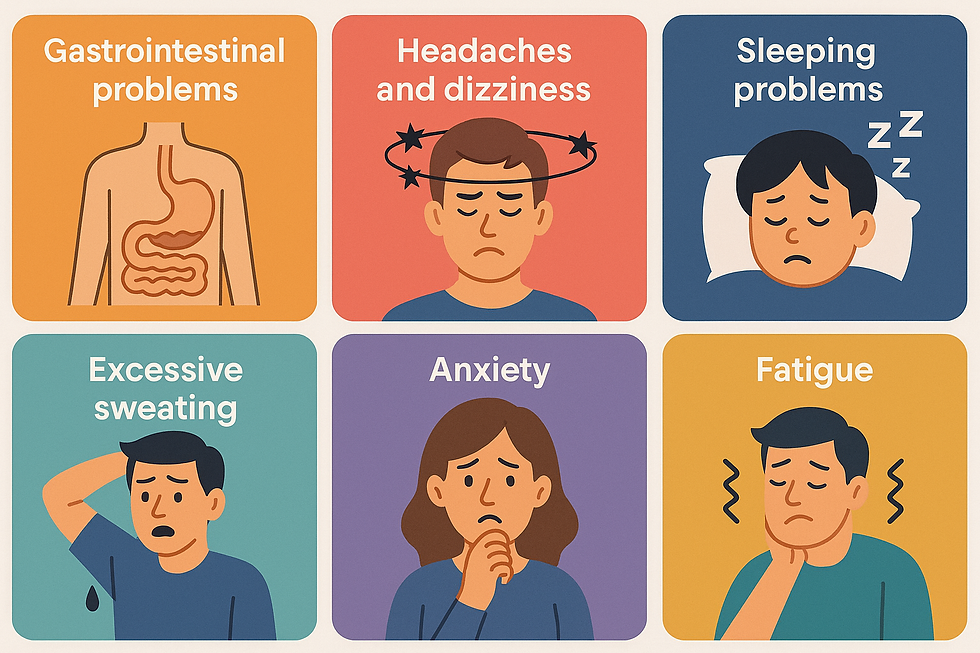
The most common temporary side effects that may appear during the first two weeks of treatment include:
❗IMPORTANT: In the case of antidepressant medications such as SSRIs, there may be a temporary increase in suicidal thoughts and heightened anxiety at the beginning of treatment. It’s also often observed that psychomotor activation (energy and motivation to act) improves earlier than mood itself.
When this early increase in energy coincides with persistent suicidal thoughts, it can, unfortunately, raise the risk of acting on them. For this reason, during the initial phase of treatment, doctors often prescribe short-term calming or anxiolytic medications to help minimize this effect and ensure safety. ❗
This also highlights the importance of close collaboration and regular contact with your doctor — it allows for timely adjustments and helps find the treatment that will be both safe and effective for you.
Question #5: Do these medications cause addiction?
Answer: In most cases — no. There are indeed some medications with addictive potential, but they represent a small minority and are prescribed only for specific, well-defined indications (and contraindications).
When these medications are taken exactly as prescribed, under proper medical supervision, they can provide significant relief and support without posing a risk of addiction.

✅ Antidepressants, antipsychotics, and mood stabilizers do NOT cause addiction.
❗Some medications used for anxiety, sedation, or sleep may have addictive potential — specifically:
☛ Benzodiazepines (examples: Xanax, Alprox, Lorafen, Clonazepam)
☛ Non-benzodiazepine hypnotics, the so-called “Z-drugs” (examples: Nasen, Stilnox, Zolpic, Imovane)
☛ In individuals with a tendency to misuse substances, even pregabalin may carry a small risk of dependence
✅ It’s also important to remember that there are anti-anxiety and sleep medications that do NOT carry an addiction risk. If you’re concerned that your doctor might prescribe something potentially habit-forming, don’t hesitate to ask or mention that you’d prefer a non-addictive option — there are safe alternatives available.
Examples of non-addictive calming medications include the widely used hydroxyzine, as well as promethazine (Diphergan), buspirone (Spamilan), and opipramol (Pramolan).
❗Stimulant medications used in the treatment of ADHD, such as methylphenidate or amphetamine, have a low potential for addiction — mainly when misused (taken in higher-than-prescribed doses or by non-oral routes). When taken exactly as prescribed, the risk of dependence is minimal.
An interesting fact (as I mentioned in my article on ADHD pharmacotherapy): since early 2025, lisdexamfetamine has also been available in Poland. It’s a form of amphetamine chemically bound to the amino acid lysine — it becomes active only after enzymatic hydrolysis in red blood cells, which eliminates the euphoric effect and virtually removes the risk of addiction.
Non-stimulant medications, such as atomoxetine, do not carry any addictive potential.

Question #6: Will I still be able to work, drive, and take care of my children while on medication?
Answer: Yes. The goal of treatment is to improve your daily functioning — to help you return to your normal activities such as working, driving, and caring for your loved ones. However, it’s important to be patient, as many psychotropic medications take some time to reach their full therapeutic effect and achieve stable levels in the blood and cerebrospinal fluid.
For antidepressants, this usually takes around 2–3 weeks, though the exact timing varies from person to person — some patients may notice early improvement sooner. Symptoms also tend to improve gradually and at different rates: energy and motivation often return first, followed by better mood, sleep, ability to feel pleasure, and overall well-being.
Some patients worry about feeling overly drowsy or “slowed down.” This is an important consideration when choosing both the type of medication and the time of dosing. Certain medications have sedative properties, which can actually be beneficial if sleep problems are a major issue. However, that sedative effect should not persist during the day — especially for those whose alertness is critical (e.g., professional drivers, people working at heights, or members of uniformed services).
Fortunately, there is always the option to select an appropriate medication that provides the therapeutic benefit without daytime sedation or impairment.
Question #7: Will psychotropic medications make me gain weight or lose my libido?
Answer: The topic of side effects is extremely important to patients — and it should be equally important to the doctors prescribing these medications. Every substance can cause unwanted effects (this applies even to widely used herbal remedies or dietary supplements!).
Therefore, psychotropic medications can also cause side effects.
The table below illustrates the most common possible side effects associated with psychotropic treatment:
Type of Medication | Most Common Side Effects |
Antidepressants (SSRIs, SNRIs, TCAs, NaSSAs) | • Gastrointestinal issues (nausea, diarrhea, constipation) • Headaches and dizziness • Increased anxiety during the first phase of treatment • Sleep disturbances (insomnia or drowsiness) • Decreased libido and sexual dysfunction • Excessive sweating • Dry mouth • Weight gain (more common with NaSSA and TCAs) |
Anxiolytics (benzodiazepines, pregabalin, buspirone, antihistamines) | • Drowsiness, psychomotor slowing • Problems with concentration and memory • Dizziness • Muscle weakness • Risk of dependence (especially benzodiazepines) • Withdrawal symptoms if stopped abruptly |
Antipsychotics (typical and atypical neuroleptics) | • Drowsiness and sedation • Weight gain • Metabolic syndrome (increased glucose, cholesterol, triglycerides) • Extrapyramidal symptoms (muscle stiffness, tremors, akathisia) • Dry mouth, constipation • Hormonal disturbances (e.g., hyperprolactinemia) • Dizziness when changing posture (orthostatic hypotension) |
Mood stabilizers (lithium, valproic acid, carbamazepine, lamotrigine) | • Hand tremors (lithium, valproates) • Dizziness • Weight gain (lithium, valproates) • Gastrointestinal disturbances • Hair loss (valproates) • Problems with memory and concentration • Laboratory test abnormalities (e.g., liver, kidney, or thyroid function) • Skin rashes (especially lamotrigine) • Drug–drug interactions |
It’s important to remember that each of the medication groups listed above includes different substances, which may vary in tolerability and side-effect profiles — partly due to differences in their mechanisms of action, even within the same drug class.
This means that not all medications in a given group cause the same side effects.
For example:
⮱ Some antidepressants do not cause sexual side effects — and certain ones may even help improve sexual function impaired by other medications.
⮱ Atypical antipsychotics are associated with a significantly lower risk of extrapyramidal symptoms, and the newest agents additionally carry minimal metabolic and hormonal risk.
⮱ Not all anti-anxiety medications are addictive — there are safe, non-addictive alternatives available.
The choice of medication is always an individualized decision, made jointly by the doctor and the patient, based on the patient’s symptom profile, treatment history, tolerability of previous medications, and other relevant clinical factors.
Nevertheless, if you’re concerned about any potential side effects, let your doctor know. This will help select the medication best suited to your individual needs and, if necessary, allow for dose adjustments or switching to another substance with a more favorable side-effect profile.
Collaboration and open communication with your doctor are essential to ensure that treatment is not only effective, but also well-tolerated.
Question #8: Will I have to take these medications for the rest of my life?
Answer: It depends — but in most cases, no. The duration of pharmacotherapy depends primarily on the type of disorder being treated, but also on several other factors, such as:
whether this is your first episode or a recurrence,
whether relapses occurred after stopping medication in the past,
how severe the symptoms were and how quickly improvement was achieved,
the presence of coexisting conditions (physical or mental),
and your life circumstances and stress levels in daily functioning.
Sometimes treatment lasts for a few months, sometimes longer — but this does not mean you’ll be taking medication for life.
The goal of treatment is always to restore independence and improve quality of life. Decisions about the duration of therapy are made together with the patient, taking into account their needs, health history, and lifestyle.
For instance:
Disorder / Diagnosis | Estimated Treatment Duration | Notes |
First episode of depression | 6–12 months after symptom remission | Stopping treatment too early increases the risk of relapse |
Recurrent depression (another episode) | Minimum 1–2 years, sometimes longer | The more relapses occur, the more often long-term treatment is recommended |
Generalized Anxiety Disorder (GAD) | 6–18 months, depending on response | Psychotherapy is also strongly recommended in parallel |
Obsessive–Compulsive Disorder (OCD) | Often long-term, 1–3 years, sometimes chronic | Pharmacotherapy combined with cognitive–behavioral therapy (CBT) |
Bipolar Disorder (BD) | Usually continuous treatment (mood stabilizers) | The goal is to prevent manic and depressive episodes |
Schizophrenia | Typically long-term or lifelong treatment | Key goal: prevent relapse and maintain remission |
Psychotic episode without a schizophrenia diagnosis | Minimum 1–2 years after symptom remission | For recurrent episodes, long-term treatment may be considered |
Adjustment disorders / short-term stress reactions | 3–6 months, often shorter | Symptomatic medication, usually short-term |
ADHD in adults | Long-term treatment, often lasting years | Individual decision based on functional needs — medication is not always required |
Primary insomnia | Symptomatic pharmacotherapy — as short as possible (usually up to a few weeks) | Focus on sleep hygiene and CBT-I (Cognitive Behavioral Therapy for Insomnia) |
Question #9: What happens if I stop taking my medication?
Answer: That largely depends on how the medication is discontinued — whether it’s done in consultation with your doctor or on your own.
When your doctor decides to stop a medication, it’s always preceded by an evaluation of whether there’s a risk of symptom recurrence, and if so, how significant that risk may be. If you follow medical guidance — typically gradually tapering the dose to allow observation of any returning symptoms — you usually won’t experience any concerning effects.
However, abruptly stopping many psychotropic medications can lead to unpleasant discontinuation symptoms. These do not mean that your illness has returned — they are caused by a sudden drop in the medication’s level in your blood and brain. Such symptoms usually resolve within a few days.
This phenomenon is sometimes referred to as a discontinuation syndrome, even though — as mentioned earlier — these medications are not addictive in most cases.
Discontinuation symptoms may include, among others:

Question #10: What if I become pregnant while taking medication?
Answer: If you find out you’re pregnant while taking psychotropic medication, the most important thing is not to stop your medication on your own. Suddenly discontinuing treatment can be dangerous for both you and your developing baby — it may trigger a relapse of symptoms or worsening of your mental state, which can, in turn, negatively affect the course of your pregnancy.
In this situation, you should contact your doctor as soon as possible. Your psychiatrist will assess:
⇛ the risk of continuing the current medication during pregnancy,
⇛ whether it’s possible to switch to a drug with a better-documented safety profile,
⇛ if the dose should be adjusted,⇛ and what additional support can be introduced (e.g., psychotherapy).
There are psychotropic medications that can be used safely during pregnancy when the benefits of treatment outweigh the potential risks. The key is an individualized approach and a shared decision between the patient and the doctor — one that prioritizes both the mother’s health and the baby’s safety.
I will discuss this topic in more detail in my upcoming article “Are Psychiatric Medications Safe During Pregnancy?”
When it comes to discussing specific drug groups and individual substances — I’m planning a series of articles that will take a closer look at particular classes of psychotropic medications and selected compounds — explained practically, accurately, and in clear, accessible language.
Thank you for reading all the way to the end! 💚I hope this article has helped to dispel at least some of your concerns about starting psychopharmacological treatment.
Bibliography:
1) "Ocena skuteczności leków psychiatrycznych i ogólnych z dystansu: przegląd metaanaliz" Stefan Leucht, Sandra Hierl, Werner Kissling, Markus Dold, John M. Davies The British Journal of Psychiatry (2012) 200, 97–106.
2) Comparative efficacy and acceptability of 21 antidepressant drugs for the acute treatment of adults with major depressive disorder: a systematic review and network meta-analysis Andrea Cipriani, Toshi A Furukawa*, Georgia Salanti*, Anna Chaimani, Lauren Z Atkinson, Yusuke Ogawa, Stefan Leucht, Henricus G Ruhe, Erick H Turner, Julian P T Higgins, Matthias Egger, Nozomi Takeshima, Yu Hayasaka, Hissei Imai, Kiyomi Shinohara, Aran Tajika, John P A Ioannidis, John R Geddes, Lancet 2018; 391: 1357–66
3) Cortese S, Adamo N, Del Giovane C, Mohr-Jensen C, Hayes AJ, Carucci S, Atkinson LZ, Tessari L, Banaschewski T, Coghill D, Hollis C, Simonoff E, Zuddas A, Barbui C, Purgato M, Steinhausen HC, Shokraneh F, Xia J, Cipriani A. Comparative efficacy and tolerability of medications for attention-deficit hyperactivity disorder in children, adolescents, and adults: a systematic review and network meta-analysis. Lancet Psychiatry. 2018 Sep;5(9):727-738. doi: 10.1016/S2215-0366(18)30269-4. Epub 2018 Aug 7. PMID: 30097390; PMCID: PMC6109107.
4) Kopcalic K, Arcaro J, Pinto A, Ali S, Barbui C, Curatoli C, Martin J, Guaiana G. Antidepressants versus placebo for generalised anxiety disorder (GAD). Cochrane Database of Systematic Reviews 2025, Issue 1. Art. No.: CD012942. DOI: 10.1002/14651858.CD012942.pub2.
5) Leucht S, Cipriani A, Spineli L, Mavridis D, Orey D, Richter F, Samara M, Barbui C, Engel RR, Geddes JR, Kissling W, Stapf MP, Lassig B, Salanti G, Davis JM. Comparative efficacy and tolerability of 15 antipsychotic drugs in schizophrenia: a multiple-treatments meta-analysis. Lancet 2013; 382(9896): 951-962.
The illustrations were created using artificial intelligence technology (OpenAI).
